Check which of your vehicles are approaching DOT compliance thresholds.
Run a free fleet risk check →OSHA cited fleet-related maintenance operations in over 1,200 inspections in fiscal year 2023, with penalty averages climbing past $15,625 per serious violation following the 2016 penalty structure reform. The citations aren't clustered around exotic hazards. They're hitting lockout/tagout deficiencies, inadequate respiratory protection during diesel particulate exposure, and — increasingly — worker positioning protocols during roadside response. If your compliance posture is built around a binder in the break room, this is worth your time.
The Regulatory Framework Most Fleet Managers Misread
OSHA's General Industry standards (29 CFR 1910) govern fixed shop operations. OSHA's Construction standards (29 CFR 1926) govern temporary worksites — which includes most roadside repair scenarios. Mobile repair technicians working on highway shoulders can fall under both depending on the nature of the work, duration, and whether a temporary traffic control zone has been established. This dual applicability is where fleets consistently get into trouble.
Check which of your vehicles are approaching DOT compliance thresholds.
Run a free fleet risk check →The agency's Multi-Employer Citation Policy also means that a fleet can receive citations for hazards created by a contractor performing mobile repair on fleet vehicles, even when the fleet didn't directly supervise the work. If the fleet controls the worksite conditions — say, a yard where a third-party mobile tire tech works — OSHA can classify the fleet as a "controlling employer" with its own obligation to correct or report hazardous conditions.
Understanding which standard applies to which environment isn't academic. The permissible exposure limits, required PPE, and documentation requirements differ meaningfully between 1910 and 1926.
Fixed Shop Operations: Where the Citations Actually Land
Lockout/Tagout Under 1910.147
29 CFR 1910.147 — the Control of Hazardous Energy standard — is consistently among the top five most cited standards in fleet maintenance environments. The specific failure mode isn't usually the absence of a program. It's incomplete machine-specific procedures.
A generic LOTO procedure that says "disconnect battery" is not compliant for a vehicle with a hybrid or electric powertrain, a wet-line hydraulic system, or a compressed-air brake system that retains stored energy after the ignition is off. For heavy-duty air brake systems, the stored pneumatic energy in tanks and lines must be explicitly addressed in the procedure — including a verification step confirming reservoir pressure has bled to zero before working on any brake component. Tri-axle dumps and platform trailers with spring brakes require caging procedures as well. OSHA's interpretation letters have made clear that a procedure omitting stored energy sources on that specific energy type is a citation-worthy deficiency.
The minimum required elements for a machine-specific LOTO procedure include: authorized employee identification, steps to shut down the equipment, location and type of each energy isolating device, type and magnitude of energy, and verification steps. For a Class 8 tractor, this typically runs to two pages when done correctly.
Respiratory Protection and Diesel Particulate Matter
Diesel particulate matter (DPM) is classified as a potential occupational carcinogen by NIOSH, and 29 CFR 1910.134 requires a written respiratory protection program any time technicians are exposed to DPM at concentrations that cannot be controlled to below the permissible exposure limit through engineering controls alone.
In a shop performing regeneration cycles on DPF-equipped engines, injector cleaning, or extended idle diagnostics in enclosed bays, ambient DPM concentrations can exceed 0.16 mg/m³ — NIOSH's recommended exposure limit — without adequate exhaust extraction. The correct engineering control is a direct-connect exhaust extraction system, not an overhead ventilation fan. Shops running tailpipe-connected extraction should be testing system performance at 75–100 feet per minute face velocity at the capture hood.
Where engineering controls are insufficient, a written program, medical evaluation, fit testing, and training are all mandatory before a respirator is assigned. Half-face elastomeric respirators with P100 filters are the minimum for DPM; technicians performing extended DPF cleaning or cutopen inspections should be in powered air-purifying respirators.
This also intersects with emissions diagnostics work. When technicians are chasing EGR valve fault codes like P0401 and P0403 through extended drive cycles or extended idle in an enclosed bay, DPM exposure risk is elevated. The diagnostic protocol and the safety protocol need to be written together.
Pit and Lift Safety Under 1910.179 and ANSI/ALI ALOIM
Vehicle hoisting is governed by 29 CFR 1910.179 for overhead cranes, but floor-mounted vehicle lifts fall under the General Duty Clause and the ANSI/ALI ALOIM standard, which OSHA has adopted as the industry consensus standard. Annual inspections by a qualified inspector, rated capacity placards, and functional testing of restraint systems are all required. Fleets running in-ground lifts for heavy equipment have the additional obligation of ensuring hydraulic fluid systems are inspected for degradation — a lift that drops unexpectedly under a 34,000-pound tandem axle is a fatality event.
Mobile Repair: The Regulatory Gray Zone That Isn't Gray
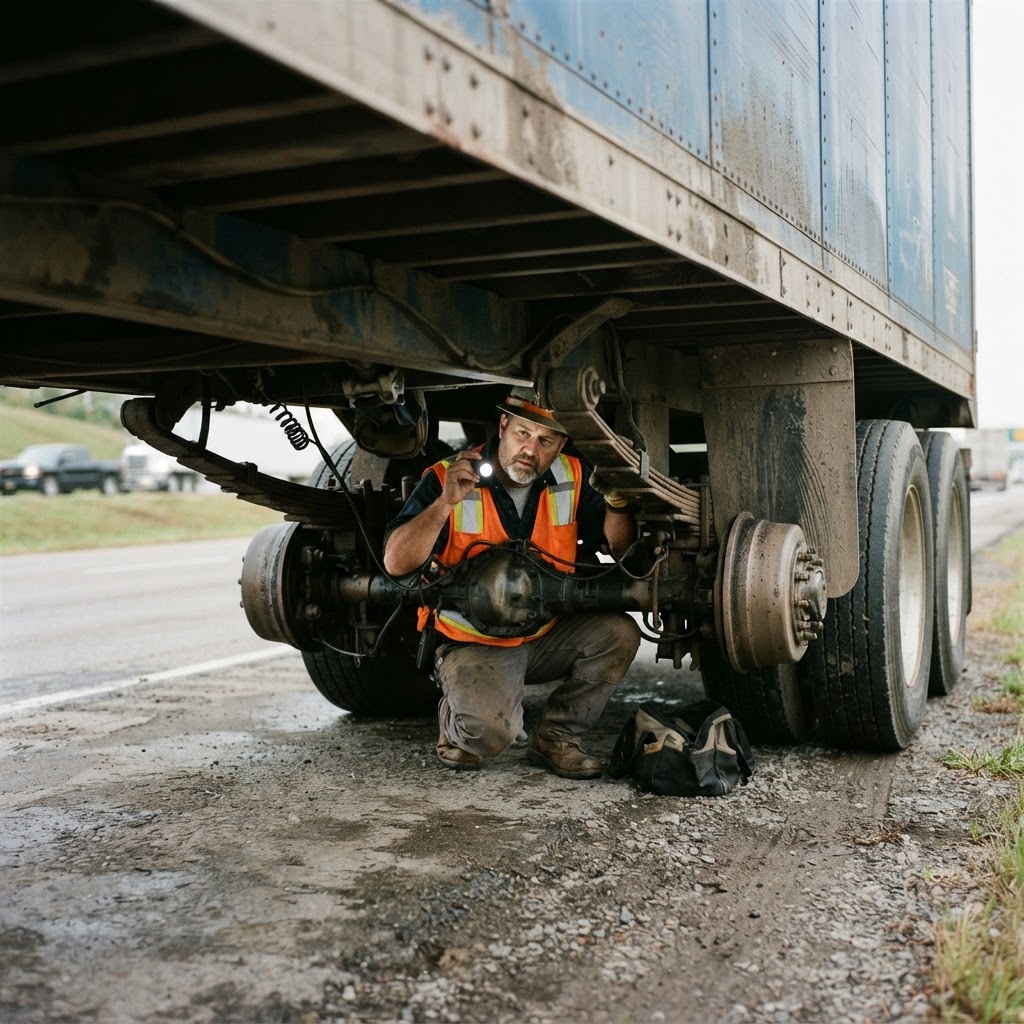
Mobile repair technicians dispatched to customer locations or roadside breakdowns operate in environments that OSHA treats as temporary worksites. 29 CFR 1926 Subpart G (Signs, Signals, and Barricades) and the Manual on Uniform Traffic Control Devices (MUTCD) govern temporary traffic control. OSHA's interpretation is consistent: if a mobile tech is working within the right-of-way of a public road, MUTCD-compliant temporary traffic control is required.
The practical requirements are more demanding than most mobile operations currently meet:
- Advance warning area: signs placed at distances calculated from posted speed and road geometry (MUTCD Table 6C-1)
- Transition area: taper with delineators channeling traffic away from the work space
- Buffer space: a minimum longitudinal buffer between the last traffic control device and the beginning of the work space
- High-visibility apparel: ANSI/ISEA 107 Class 2 minimum for speeds under 50 mph; Class 3 above 50 mph
A mobile tech who pulls a cone from the bed of the service truck and sets it ten feet behind the breakdown vehicle is not in compliance. The liability exposure here is compounded: a worker struck during a non-compliant roadside operation creates OSHA recordable and reportable events and civil liability where the inadequacy of the traffic control zone becomes an element of negligence.
For fleets dispatching mobile technicians, written safe work procedures for roadside response are not optional. They should specify minimum equipment (pre-assembled cone kits with spacing guides, arrow boards for high-speed roads), vehicle positioning (service truck upstream of the breakdown vehicle, wheels turned away from traffic), and a two-person requirement for shoulder work on highways with posted speeds above 55 mph.
The Recordkeeping Obligations That Create Secondary Exposure
Fleets with 10 or more employees must maintain OSHA 300 logs. The classification of incidents matters: a technician who strains their back moving a transmission and receives a work restriction is a recordable event under the "restricted work activity" criterion. Misclassifying recordables as first-aid cases is itself a citation-generating violation — and when OSHA inspects following a serious injury, they routinely audit the prior three years of 300 logs.
Industry data from the Bureau of Labor Statistics puts the incidence rate for musculoskeletal disorders in automotive repair and maintenance at 2.8 per 100 full-time workers — higher than general manufacturing. For heavy-duty shops working on Class 6–8 equipment, the combination of component weight and awkward access positions makes this a primary injury category. Shops that have not conducted an ergonomic assessment of high-frequency tasks — transmission removal, brake drum replacement, DPF servicing — are leaving an OSHA exposure unaddressed.
Building the Compliance Case for Budget Purposes
Directors of maintenance making the case to finance for safety infrastructure investments can use the following structure:
| Risk Category | Average OSHA Penalty (Serious) | Estimated Incident Cost (Workers' Comp + Lost Time) | Mitigation Investment | |---|---|---|---| | LOTO deficiency | $9,000–$15,600 | $38,000–$74,000 | $1,200–$3,500 (program development + training) | | Respiratory program absence | $7,500–$15,600 | $22,000–$60,000 (long-latency disease claims) | $800–$2,400/year | | Roadside TTC non-compliance | $10,000–$15,600 | $250,000–$2M+ (struck-by fatality) | $3,500–$7,000 (equipment + procedures) | | Lift inspection gap | $8,000–$15,600 | $95,000–$400,000 (crush/drop incidents) | $600–$1,200/year |
These ranges are consistent with OSHA penalty structures post-2023 adjustment and industry claims data from RIMS and the National Council on Compensation Insurance. The math on any single row justifies the mitigation spend without requiring a complex ROI model.
For mobile-heavy operations, the cost argument is sharpened by insurance underwriting trends. Carriers writing commercial auto and general liability for fleets with mobile maintenance components have begun specifically underwriting roadside response protocols as part of the renewal questionnaire. Documented TTC procedures and training records are reducing premiums in the 4–9% range with several admitted carriers.
Fleets tracking fault patterns and diagnostics across their vehicles also benefit from tighter scheduling discipline — knowing when a vehicle is likely to require roadside intervention versus shop-based work changes the risk profile of mobile dispatch. Operations that track injector fault code progressions like P0201–P0208 and balance rate drift can anticipate breakdowns and pull units before they become roadside events, reducing the frequency of high-risk mobile repair deployments entirely.
A Scenario From the Shop Floor
A 47-unit flatbed fleet based in the Midwest ran a standard diesel shop with two in-ground lifts and two mobile service trucks. In March 2023, a mobile technician was dispatched for a roadside repair on a 2019 Peterbilt 579 showing an active SPN 3216 / FMI 15 — SCR outlet NOx sensor out of range high — combined with a derate condition. The repair required approximately 45 minutes on a state highway shoulder with a posted speed of 65 mph.
The technician deployed three cones and parked the service truck six feet behind the unit. No arrow board. No taper. High-visibility vest met Class 2 but not Class 3. A passing vehicle clipped the rear cone array; the technician was not struck but the incident was reported to the state DOT. OSHA opened an investigation under the General Duty Clause. The citation totaled $28,400 across four items.
The fleet had no written roadside response procedure. They had no arrow board on either service truck. Their LOTO program existed but contained no machine-specific procedures for any vehicle in the fleet. All three deficiencies were discovered in the same inspection.
The total cost — citations, legal fees, retraining, equipment procurement, and the program rewrite — came to approximately $67,000. The SCR repair itself was under $1,800.
Fleets running predictive emissions diagnostics and DEF system fault monitoring can often catch derate-bound fault progressions early enough to schedule the repair in-shop rather than treating it as a roadside emergency.
The Bottom Line
OSHA compliance in fleet maintenance is not a paperwork problem. It's a systems problem — the gap between what your shop procedures say and what actually happens when a tech is 40 minutes from the yard with a broken-down truck on a 65-mph highway. The highest-risk exposures are predictable: LOTO procedures that don't address stored energy for specific vehicle types, respiratory programs that don't account for enclosed-bay diagnostic work, and mobile response deployments with inadequate traffic control. Each of those carries a penalty structure that eclipses the cost of the fix by a factor of ten or more.
Rouutiq gives fleet maintenance teams exactly the fault pattern visibility and early-warning intelligence needed to pull units before they become roadside events — reducing the frequency of the highest-risk maintenance scenarios before they generate an OSHA inspection. Start a free trial at rooutiq.com to see how fault code tracking and predictive diagnostics can shift more of your repair volume from the shoulder to the shop floor.
About the Author

James Park
Telematics & Fleet Strategy Editor · Rooutiq Editorial
Covers telematics integration, fleet procurement strategy, maintenance planning, and data-driven interval optimization.
Comments
Join the conversation
Free — No Credit Card
Get Your Free Fleet Fault Report
Get a personalized breakdown of the fault codes most likely to hit your fleet — with real repair costs, downtime data, and your savings estimate. A specialist follows up with your report.
No spam. A fleet specialist will reach out with your report. Unsubscribe anytime.
Avg. $14K per avoided violation
Stay DOT-Compliant Without the Paperwork Headache
A single DOT out-of-service violation costs an average of $14,000 in downtime and fines.
Rooutiq flags vehicles approaching compliance thresholds and auto-schedules inspections — keeping your fleet road-legal with zero manual tracking.
14 days free · No credit card · Setup in 5 min
Ready to Stop Guessing?
Rooutiq monitors every fault code in your fleet and tells you which ones will fail — before they do.
Start Free Trial